Stages of Embryonic Development in the Quran, Modern Embryology, and Ancient Greek Misconceptions
According to modern embryology, a child develops in the mother’s womb in several stages. First, the zygote or multicellular structure is formed through the union of the sperm and the egg. It gets stuck in the wall of the uterus and starts receiving blood supply from the uterus. Gradually, the heart, kidneys, and brain are formed, forming the shape of an immature child. Finally, when the hands, feet, spine, and muscles develop, it takes the shape of a full-fledged child. The Quran briefly describes these changes and surprisingly, these stages are similar to embryology. The Quran not only mentions human development but also the basic structural elements of the human body.
The basic description of how a human embryo develops in the womb is found in Surah Al-Mu’minun (23:12-14) :
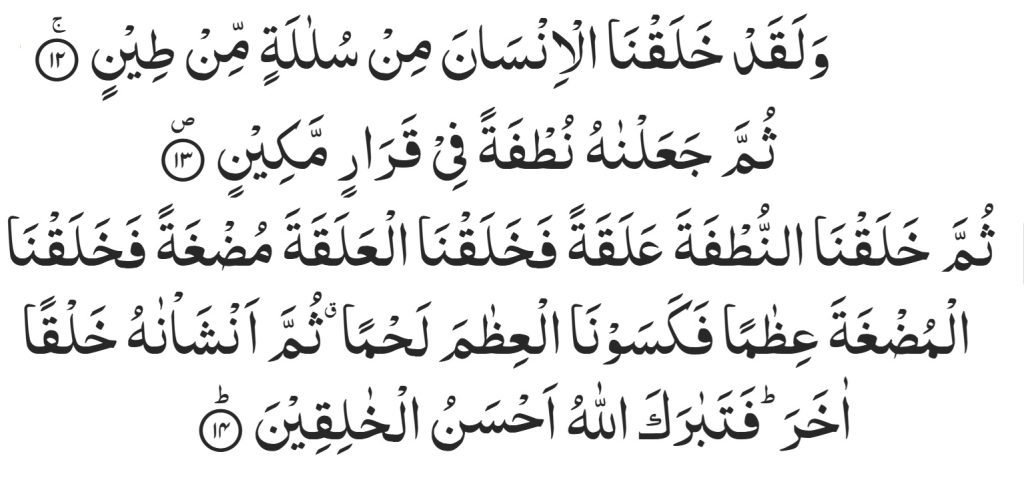
“And indeed, We created man from an extract of clay. Then We placed him in a secure place as a drop (Nutfa ). Then We made the drop a lump . Then We made the lump a lump . Then We formed him into a lump of flesh. Then We clothed the bones with flesh . Then We changed him into another creation . So blessed is Allah, the Best of creators.”
(Surah Al-Mu’minun 23:12-14 )
This verse mentions several stages of human creation:
First, it is said about the basic elements of the human body – “And indeed, We created man from an extract of clay ( سُلَالَةٍ ).” That is, the basic element of the human body is the essence of clay.
The word “sulalah” means “extraction” or “essence” – Extract / Essence / Quintessence / Refined part The Arabic dictionary Lisān al-ʿArab says- السَُّالَةُ: ما استُخِصَ من الشيس ونُزِعَ منه
Meaning: What is extracted or refined from something. The basic elements in the human body are – calcium, iron, potassium, sodium, phosphorus, oxygen, carbon, hydrogen, nitrogen, etc. Among them, oxygen, carbon, hydrogen, nitrogen, these four compounds constitute 96% of the body. These elements are mainly minerals present in the soil . Plants take them from the soil. Humans take them through food. The structural elements of the proteins, lipids, nucleic acids that are present in the human body are carbon, hydrogen, nitrogen, phosphorus, oxygen, etc. basic particles. As a result, humans are truly made up of “the essence of the soil”.
The main stages of the creation of man in the womb according to the Quran:
- Nutfa (نطفة) – a drop of fluid (sperm/embryo)
- ‘Alaqah (علقة) – clinging, hanging, like a leech
- Mudgah (مضغة) – chewed/uncooked meatball
- Bone formation ( عِظَام ) – formation of arms, legs, spine
- Skin on the bones ( لَحْم ) – the skin of flesh that forms around the arms, legs, and spine
- Transformation into another creation – ( خَلْقًا اٰخَرَ ) ؕ- The structure of a full-fledged child.
Compatibility with modern embryology
It is worth noting here that the Quran does not discuss embryology in detail, but rather only mentions the physical appearance of what an embryo looks like at different stages, which can be found in human embryology:
1. In the Quran, the first stage is called Nutfa . The word Nutfa (نطفة) means a drop of fluid, sperm/embryo. Then I placed it in a safe place as a drop (Nutfa ) . Here, the safe place is the uterus. Only when the Nutfa or sperm is placed in the mother’s womb does the process of human creation begin.
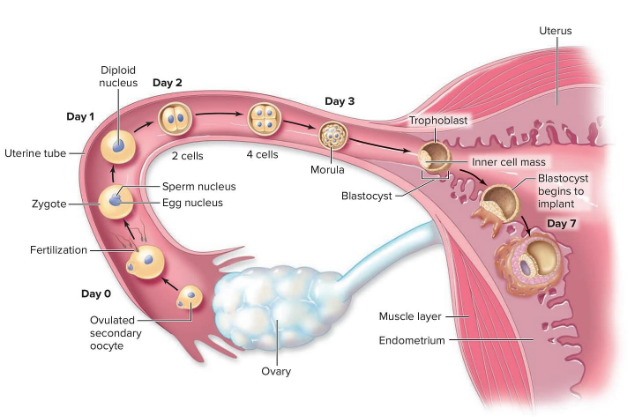
Image: The process of human creation begins when the egg or sperm is placed inside the uterus.
According to medical science, a cell called zygote is formed by the union of sperm and egg inside the uterus. The structure of a cell called zygote gradually forms 2 cells, 2 to 4, 4 to 16, 32, mathematically increasing the number of cells. In the language of embryology, it is called Morula, which is the. At this time, it first floats at the mouth of the uterine tube and from there it moves towards the inside of the uterus.
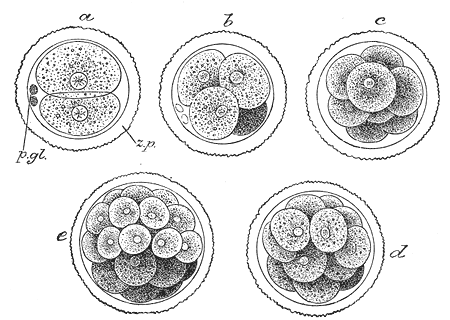
Image: When a sperm or egg fuses with a sperm , the number of cells increases from 1 to 2, 2 to 4, 4 to 16, and so on.
2. The next stage described in the Quran is ‘Alaqah (علقة) – which means hanging, stuck, like a leech, stuck. When the number of cells in the multicellular structure increases further, it is called a blastocyst and on the 6th or 7th day it gets stuck to the uterine wall, on the 10th day it completely penetrates the uterine wall. On the 12th day it starts getting blood supply from the uterine blood. And as the leech sucks blood, it starts getting blood supply from the uterine blood and starts growing. This stage is called Alaqah in the Quran. This whole process is called Implantation in medical terms.
In various Quranic translations, the word “alaqa” is translated as clotted blood, which is not entirely correct, but rather the true meaning would be hanging, stuck, like a leech, congealed, etc.
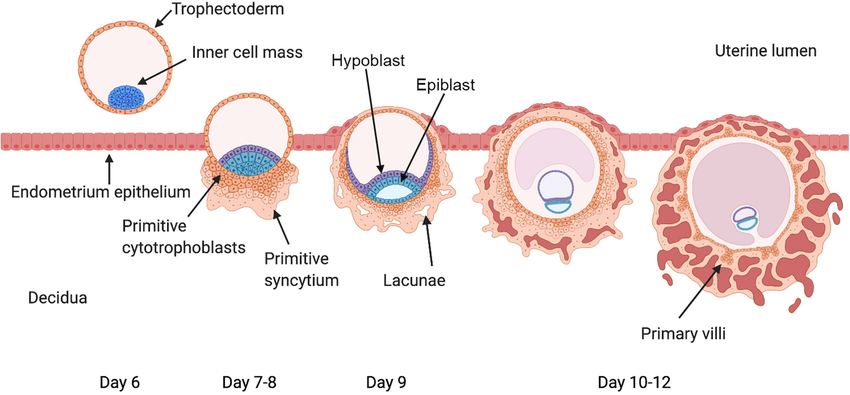
Image: The ‘alaka’ gets stuck in the wall of the uterus and continues to receive blood supply from there.
3. The next step is مضغة which means an incomplete piece of flesh/meat, – A small piece of flesh/meat (the amount that fits in the mouth to be chewed), usually used to indicate small quantity or early/incomplete form.
The blastocyst cells gradually divide into three layers. Each layer begins to develop different organs such as the heart, nervous system, and digestive system. It looks like an immature baby because its arms, legs, brain, and eyes are not yet fully developed. That is why it is called a مضغة or a piece of immature flesh or a piece of food chewed by the teeth.
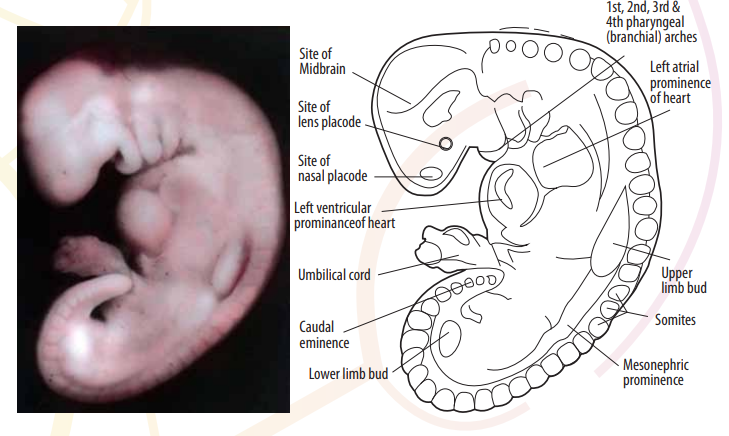
Image: ‘Alaka’ gradually takes the form of a half-naked baby, called a مضغة . It has no arms or legs, so it is described as a piece of half-naked flesh or a piece chewed with teeth.
4. The next stage in the Quran is called bone formation ( عِظَام ). At the beginning of the 4th week, soft bone structures are formed, the human limbs, and the spine begin to form. Gradually, between the 7th and 8th weeks, the human body begins to develop into a hard bone structure.
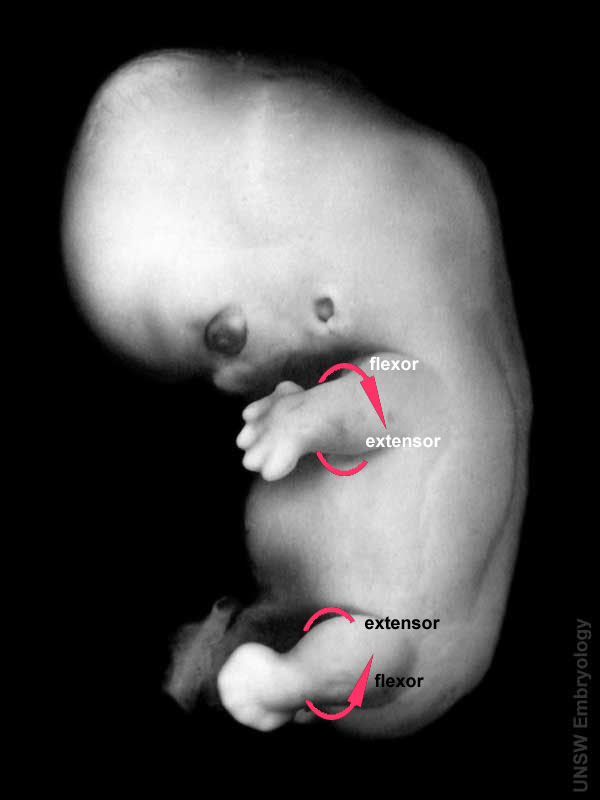
Photo: Slowly, the arms, legs, and spine begin to form in the embryo, first soft bones and then hard bones are formed, over which a covering of flesh forms.
5. The human body begins to develop muscles between the 4th and 5th weeks. Between the 5th and 6th weeks, muscle cells begin to form a muscular structure around the bones. This stage is called mudgah in the Quran. It is called the covering of flesh ( لَحْم ) on the bones .
This migration and cell differentiation can be observed from the fifth week [1.3.3]. Usually by the sixth week (36 days), myoblasts enter the limb bud and form dorsal and ventral muscle bundles.
It should be noted here that bone and muscle development begin at about the same time, but
6. By about 8 weeks of pregnancy, all the organs of the baby’s body, hands and feet, brain, heart, kidneys are formed and the baby continues to grow in the mother’s womb for about 9 months. The Quran calls this stage the transformation into another creation .
That is – Nutfa / sperm -> safe place in the uterus -> Alaka / zygote / morula gets stuck in the wall of the uterus -> Mudgah or incomplete structure without arms, legs and spine is formed -> Izam and Laham / formation of arms, legs and spine -> complete child / new creation.
| Order | Quranic Stage | Medical / Embryology | Timeframe (days/weeks) | Detailed description (in brief) |
|---|---|---|---|---|
| 1 | Nutfah (Nutfah) | Zygote → Cleavage → Morula |
Day 1 → Day 4–5 (Marula: Day 4) |
Sperm + egg → zygote → 2, 4, 8, 16, 32 cells… Arithmetic growth → small ball-like cell cluster |
| 2 | Alaqah (علقة / Alaqah) | Blastocyst → Implantation |
Day 5–6 → Day 6–7 → Day 10 → Day 12 | Blastocyst attaches to the uterine wall, absorbs blood → hanging like a jock / blood collection condition |
| 3 | Mudghah (مضغة / Mudghah) | Gastrulation → Three layers (Ectoderm, Mesoderm, Endoderm) |
Week 3 (Days 15–21) → Week 4 begins | Formation of three germ layers → Early beginnings of heart, nerves, digestive system → Shaped like a piece of chewed meat |
| 4 | Creation of Bones (عِظَام / Izam) | Cartilage model → Skeletal framework |
Week 4–5 → Week 6–8 | Hands and feet and soft bone structure → Gradually forming a hard bone frame |
| 5 | Meat Covering (لَحْم / Lahm) | Muscle formation (Myogenesis) |
Week 4–5 begins → Week 6–8 | Muscles form around bones → Body shape is clear due to bones + flesh |
| 6 | Transformation into another creation (Different creation) |
End of embryonic stage → Fetal stage | Week 8 ends → Week 9 until birth | All major organs complete → human form clear, growth and maturity |
Modern embryology, which is based on the microscope and modern technology, coincides remarkably with these stages:
In the language of embryology, the part up to the Nutfa and Alaka stages is called the Pre-embryonic stage, which is the first 2 weeks in the mother’s womb. The Mudga, Izam and Laham stages are called the Embryonic stage , which is the first 3 to 8 weeks in the mother’s womb. The last or Khaliqin stage is called the Fetus or full-fledged child , which is from the 8th week in the mother’s womb until the baby is born.
The development of the human embryo described in the Quran, when analyzed linguistically and scientifically, is consistent with modern embryology . This bears evidence of the miracle of the Quran.
Many people say that the embryology in the Quran was taken from the ancient Greeks and copied into the Quran. Now let’s see what the ancient Greeks thought about embryology:
Hippocrates (460–370 BC) : In his work On the Nature of the Child, Hippocrates described how sperm are produced from the entire body of each parent, and stronger sperm are produced from the stronger parts. The embryo is formed from a mixture of the male’s semen and the female’s contribution (often considered menstrual blood). Development occurs in stages: the seed is enclosed in a membrane and grows as the mother’s blood descends into the uterus, which causes menstruation to cease. Flesh is formed from coagulated blood, via the umbilical cord, then the bones harden like the branches of a tree. Breath plays a role in the formation of various organs.
Aristotle (384–322 BC) : In On the Generation of Animals , Aristotle elaborated on the theory of epigenesis, stating that the embryo is produced by the male’s sperm acting on the mother’s menstrual blood (the “substance” provided by the mother), much like milk curdling. The stages include: initial stabilization and separation of the solid-liquid parts, formation of the membrane (choria); blood vessels from the heart connect to the uterus via the umbilical cord to provide nourishment; organs such as the heart first appear. Flesh and bone are formed by mixing the elements earth with water or air. Nerves are formed from earth and air, nails from solid water, bones from earth and water.
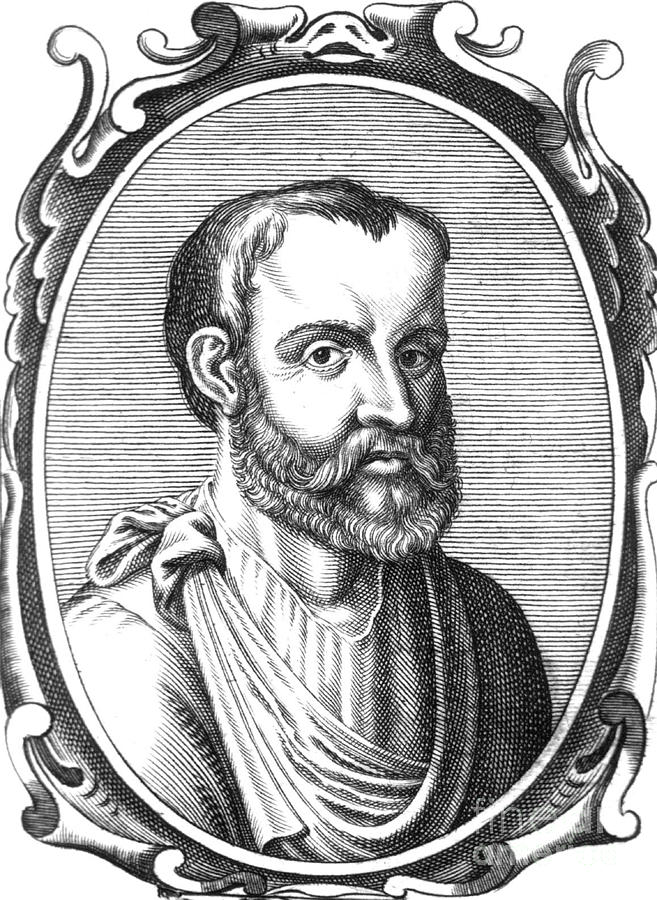
Photo: Galen, he believed that sperm mixed with menstrual blood to form an embryo.
Galen (129–216 AD) : Galen believed that the embryo was formed by the mixing of male semen and female menstrual blood, which he considered “female semen.” This idea is called the two-seed theory . He did not consider the female contribution to be as active as that of the male—the female blood merely provided “material,” the male semen provided “form.” Galen said that if the embryo was on the right side of the uterus (due to heat), it was male; if it was on the left, it was female. He believed that the female body was an incomplete or weak male body .
In On Semen , Galen synthesized and expanded on Hippocratic and Aristotelian ideas, proposing four stages: the sperm mixes with menstrual blood in the uterus as a seed; initial formation from this mixture; gradual differentiation into flesh, organs, and bone; and final solidification. He described the embryo as receiving nourishment from the mother’s blood through blood vessels, with bones forming from the earthy part and muscles surrounding it.
From the above discussion, it is clear that the ancient Greeks had numerous misconceptions about embryology. They all believed that a child is born when the male sperm mixes with the female menstrual blood. However, the Quran does not contain such misconceptions. If the Quran had borrowed information from the Greeks, their misconceptions would also have been written in the Quran. Rather, the Quran accurately describes the physical sequence of how a baby grows in the mother’s womb.
References:
Tortora & Derrickson
Principles of Anatomy and Physiology , 16th Edition- (Elements of human body: C, H, O, N, Ca, P, K, Na, Fe).
Hippocrates – On the Nature of the Child , Hippocratic Corpus
Aristotle – On the Generation of Animals , Book II–IV
Galen – On Semen , On the Formation of the Fetus
Related post-
Human chromosome number in Quranic verses
Chromosome numbers of various animals in Quranic verses