Let us find answers to a few questions:
1. The fossil record identifies hominids, human-like creatures that lived hundreds of thousands to millions of years ago.
2. Are the human-like hominids found in the fossil record descendants of Adam?
3. Were there other intelligent races living on Earth before Adam? Did new species emerge through the replacement of Hominid animals from Adam?
4. What is the difference between Bani Adam and other Hominids?
5. Milestones in human history: The development of civilization, agriculture, and metallurgy, etc., was achieved through the descendants of Adam, not through other species.
6. So is the theory of evolution true?
——–
1. The fossil record identifies hominids, animals that look like humans and lived hundreds of thousands of years ago .
According to the conventional interpretation of biology and evolutionary theory, humans and other animals did not suddenly emerge one day; rather, simple organisms gradually transformed into complex organisms through gradual changes over billions of years. This long process is called evolution . The first organisms originated in aquatic environments, as single-celled organisms. Later, these organisms gradually transformed into multicellular organisms, which were able to adapt to different environments on land, water, and in the sky. As a result of this adaptation, various types of animals emerged. Here is a brief discussion of how humans evolved:
According to the theory of evolution, dinosaurs lived on Earth about 65 million years ago , probably due to a meteorite impact, the dinosaurs suddenly became extinct. But small mammals survived, after the dinosaurs became extinct, primates (monkeys, apes, etc.) emerged from these small mammals. They were tree-dwelling and agile animals.
About 25 to 30 million years ago , these primates split into two groups. One group spread to the Americas — these were the New World Monkeys. The other group spread to Africa and Asia — these were the Old World Monkeys. From these Old World monkeys, a new branch of monkeys split off — the Apes. These apes later evolved into gorillas, chimpanzees, and humans.
Then, about 7 to 10 million years ago , somewhere in Africa, an animal arose that was neither fully human nor fully chimpanzee. It was the Last Common Ancestor (LCA) of humans and chimpanzees . It walked in trees, but also descended to the ground when necessary.
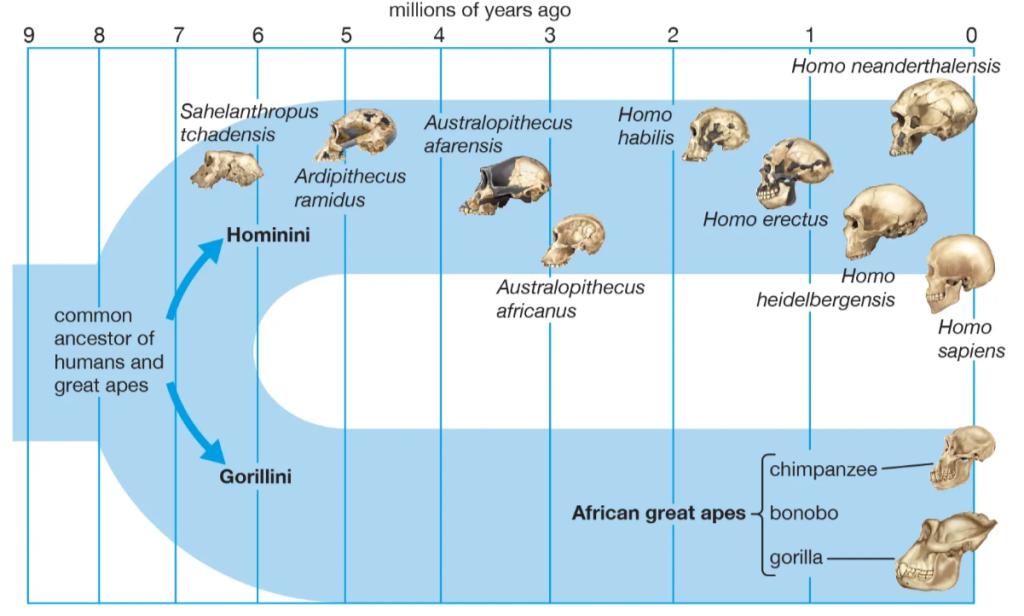
About 7 million years ago, humans split off from this ancestor into their own branch, which scientists call the Hominin Line. First came Sahelanthropus tchadensis, which is thought to be one of the earliest human ancestors. Next came Australopithecus, which walked partially upright and lived in various parts of Africa. Homo habilis, about 2.4 million years ago, learned to use tools first. Then came Homo erectus, about 1.9 million years ago, which walked completely upright and spread out of Africa for the first time into Asia and Europe.
Then a special species appeared in history — Homo neanderthalensis , who survived on Earth from about 400,000 to 40,000 years ago . They were strong, adapted to cold climates, used fire and even practiced burial rituals . They also participated in genetic mixing (interbreeding) with modern humans.
Another species existed at this time — the Denisovans , who lived at the same time and also had some genetic connection to modern humans.
Finally, about 300,000 years ago , a new species emerged—Homo sapiens, or modern humans. They gradually spread from Africa to the rest of the world.
Meanwhile, the branch from which humans split off gave rise to chimpanzees and bonobos . Humans share about 98% of their genetic similarity with them .
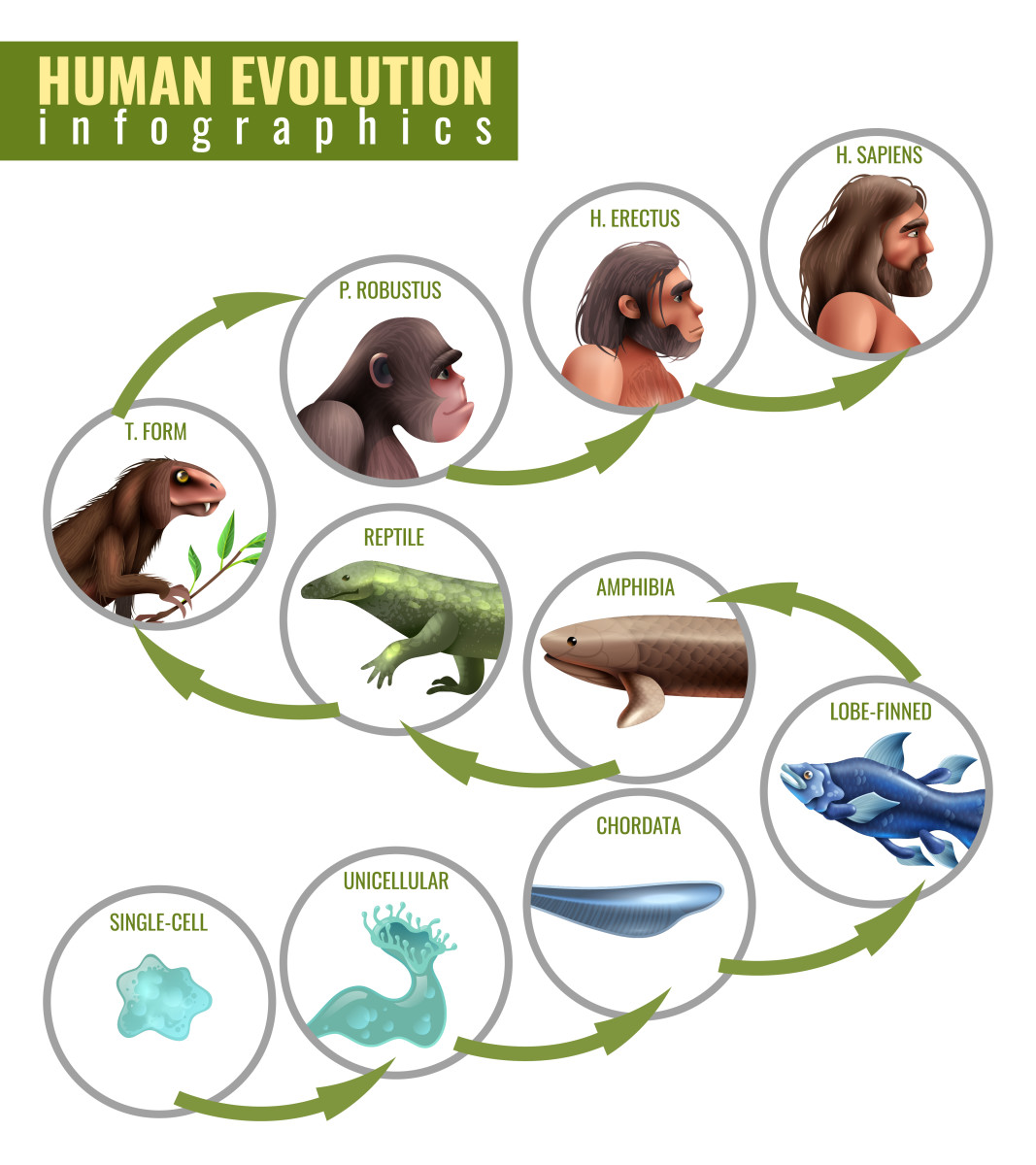
Below is a brief summary of the sequence of human evolution:
1. Dinosaurs –>>> Dinosaurs became extinct and primates emerged (about 65 million years ago)
2. The split of monkeys and apes from primates (about 25–30 million years ago )
3. The ancestor of apes and humans (about 7–10 million years ago): Last Common Ancestor (LCA)
4. Hominin Line (from about 7 million years ago): This line of direct ancestors of humans is called Hominin . Its important stages are:
- Sahelanthropus tchadensis (about 7 million years ago): Considered the oldest possible ancestor of humans.
- Australopithecus (4–2 million years ago): Walked partially upright, lived in various parts of Africa.
- Homo habilis (2.4–1.4 million years ago): Known as the first tool user.
- Homo erectus (1.9 million – 100,000 years ago): Walked completely upright and spread out of Africa into Asia and Europe.
- Homo neanderthalensis lived from 400,000 years ago to about 40,000 years ago .
- Denisovan- They existed about 400,000 years ago – until about 40,000 years ago.
- Homo sapiens (about 300,000 years ago): Modern humans emerge and gradually spread to all corners of the globe.
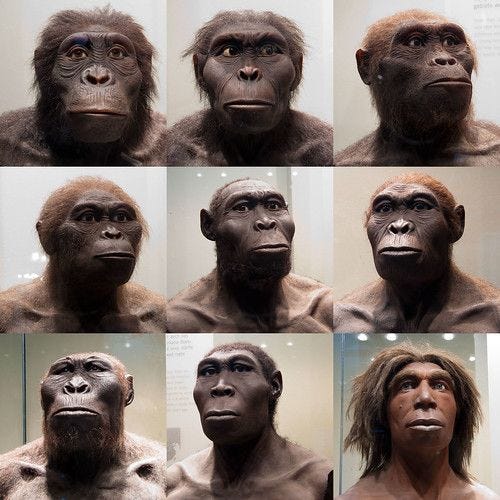
2. Are these human-like creatures found in the fossil record descendants of Adam ?
To know whether modern humans, Homo sapiens , who have been living for about 300,000 years in the fossil record, are descendants of Adam, we need to know when Adam came to earth. There is no definitive information on this. A verse in the Quran shows that Adam, Noah, and Abraham were related to each other by lineage. The word ذُرِّيَّة is used in the Quran for them, which means offspring , descendants .
It is said in Surah Al Imran, verses 33-34:
Indeed, Allah chose the family of Adam, Noah, Abraham, and the family of Imran over the worlds. They are descendants (ذُرِّيَّة ) of one another . AndAllah is All-Hearing, All-Knowing .

Those were ˹some of˺ the prophets who Allah has blessed from among the descendants of Adam, and of those We carried with Noah ˹in the Ark˺, and of the descendants of Abraham and Israel,1 and of those We ˹rightly˺ guided and chose.
In surah Maryam verse – 59:
Those were they unto whom Allah bestowed His Grace from among the Prophets, of the offspring of Adam, and of those whom We carried (in the ship) with Nuh (Noah), and of the offspring of Ibrahim (Abraham) and Israel and from among those whom We guided and chose.
Ibn Kathir, in his Tafsir, describes the genealogy of Noah (peace be upon him). He writes:
Noah, the son of Lamech, Lamech the son of Methuselah, Methuselah the son of Enoch, Enoch the son of Id, Id the son of Mahalaleel, Mahalaleel the son of Cainan, Cainan the son of Enosh, Enosh the son of Seth, Seth the son of Adam (alaihimus salam).
Adam → Seth → Enosh → Cainan → Mahalalil → Iad → Enoch (Idris) → Methuselah → Lamech → Noah (PBUH)
If we follow the sequence of the arrival of the Prophet (peace be upon him), we can get some idea of how long ago Adam (peace be upon him) was on earth. The sequence of the prophets is roughly – the order
of the major prophets is usually understood as follows: Adam → Idris → Noah → Hud → Salih → Abraham → Lot → Ishmael → Isaac → Jacob → Joseph → Shuaib → Moses → Aaron → David → Solomon → Yunus → Zechariah → John → Jesus → Muhammad (peace be upon them).
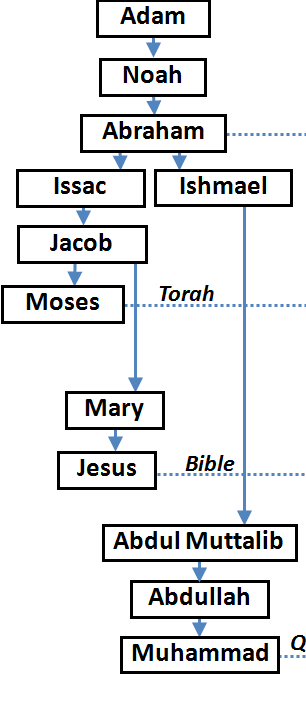
Approximate chronology Based on the above information, an approximate chronology is as follows, although the specific dates are approximate:
- Adam : ~6,000–12,000 years ago (4000–10,000 BC, estimated, based on Judeo-Christian genealogy).
- Noah : ~3,000–8,000 BC (several centuries or millennia after Adam).
- Abraham : ~2000–2500 BC.
- Moses : ~1400–1200 BC.
- David/Suleiman : ~1000–900 BC.
- Jesus : ~4 BC–30 AD.
- Muhammad (PBUH) : 570 AD–632 AD.
- Present : Approximately 1,400 years since the death of Muhammad.
That is, we can say that the possible time of Adam’s arrival on earth is 6,000 to 12,000 years. However, according to the fossil record, Homo sapiens or humans were on earth about 300,000 years ago. On the other hand, the Quran mentions that Adam was created directly from the elements of the earth and mentions Adam, Noah and Abraham as descendants of each other. Therefore, it is unlikely that Adam came to earth 300,000 years ago.
3. Were there other intelligent races living on Earth before Adam? Did new species emerge through the replacement of Hominid animals from Adam?
So we can say that the old fossils that are found are probably not descendants of Adam and Eve. Rather, they are other species like humans that lived before Adam came to Earth.
The question is-
1. Did other animals like humans live on Earth before Adam?
2. Were they intelligent?
3. Did Allah create a new species called humans or Al-Insan through Adam (peace be upon him) instead of the previously created animals?
We know that the jinn have been living on earth for a long time. There is a lot of information about this in the Quran, Hadith and Tafsir books. However, there is no clear information in the Quran or Hadith about whether other creatures that looked like humans lived on earth or not. In verse 30 of Surah Al-Baqarah, some information is available about the beginning of the creation of man, where Allah Almighty has mentioned man as a ‘Khalifa’. In the interpretation of this word ‘Khalifa’, many commentators have mentioned the existence of other creatures like man long before Adam (peace be upon him).
Surah Al-Baqarah – Verse 30 states:
And remember when your Lord said to the angels, ‘I am going to create a vicegerent (خَلِيفَةً ) on earth.’ They said, ‘Will You place therein one who will spread corruption and shed blood ? While we glorify You with our praise and glorify You.’ He said, ‘I know what you do not know.’
In this verse, Allah declares mankind as the vicegerents (خَلِيفَةً ) . The angels express their fear that humans will cause chaos (sad) and bloodshed (safk al-damaas) on earth . Allah responds by saying, “I know what you do not know” — implying that there is a greater and deeper purpose behind the creation of humans that is beyond the knowledge of the angels. Two things are quite important in this verse:
1. What does the word Caliph mean?
2. How could the angels say that humans would cause chaos and bloodshed on earth?
Let’s see what the word Caliph means according to the Arabic dictionary.
The meaning of the word خَلِيفَةً (Khalifah) – According to the Arabic dictionary: Root: خ ل ف (kh-l-f) . The basic idea of this root is: to come after , to be someone’s successor , or to be someone’s representative . According to the Classical Arabic dictionary:
1. Lisān al-‘Arab (Lisaan al-‘Arab): A caliph is someone who succeeds another and takes his place. A caliph is the representative of Allah on earth, who carries out His commands and prohibitions.
2. Al-Mufradāt – Raghib al-Asfahani:
English meaning: Khilafah means to carry out a duty on behalf of someone else—either due to that person’s absence or death.
خَلِيفَة (Kh ل ف) — representative / successor / representative ruler / successor / to come behind, to follow someone
So we can see that the meaning of the word Caliph is quite broad and in Arabic this word means representative / successor / representative ruler / successor, coming behind, following someone, etc.
Imam Qurtubi presents various interpretations of the word خَلِيفَة in this verse :
- Adam (peace be upon him) is the representative of Allah , who will rule the earth under Allah’s guidance .
- Adam (peace be upon him) is the descendant of the jinn or any other creature who lived on earth before Adam and caused unrest and bloodshed.
- The beginning of the continuous succession of mankind , that is, one generation after another will come.
Ibn Kathir said: ” Khalifa ” means a nation that will succeed one another. On the other hand, it is wrong to say that humans are the caliphs and representatives of Allah in this world.
Here it is mentioned that the angels told Allah about a nation that would not only cause chaos but also cause bloodshed. The jinn do not have blood in their bodies, they are made of a substance like light. They do not have blood in their bodies. The Quran clearly states that the jinn were created from fire:
- Surah Ar-Rahman (55:15): “He created the jinn from a smokeless flame.”
- Surah Al-Hijr (15:27): “And We created the jinn before that from a smokeless flame of fire.”
So the people the angels were talking about were not the jinn. The angels were talking about people who used to fight like humans and had blood in their bodies. Surprisingly, the commentators have mentioned the different peoples that existed before humans. Ibn Kathir mentioned in his book Al-Bidaya wan Nihaya :
“The jinn were created before Adam (peace be upon him). And before them, there were Hin and Bin on earth. Then Allah gave the jinn power over them, so they killed them, expelled them, and wiped them out from the earth and began to live here themselves.” (Al-Bidaya wan Nihaya, Ibn Kathir, p. 50)
Al-Masudi (Murjuz-Dhahab, Vol. 1):
He wrote that before Adam, Allah created many nations and different forms—some of whom were peaceful, while others were violent and bloodthirsty.
Al-Masudi wrote:
“Allah created 28 nations before Adam (peace be upon him), each with a different appearance.”
He described some of them:
- Some had wings, their words were like thunder.
- Some had a body like a lion, a head like a bird, hair and a tail.
- Some had two faces—one in front, one behind—and many legs.
- Some were half human, with one arm and one leg, and their speech was like the call of a stork.
- Some had a face like a human, a back like a turtle, horns on their heads, and a voice like the barking of a dog.
- Some had white fur and a tail like a cow’s.
- Some had teeth as sharp as knives, and their ears were long.
(Al-Masudi’s Tarikh-ul-Umam)
That is, we can say from the interpretation of the word ‘Caliph’ and the statements of the commentators that long before the arrival of Adam (peace be upon him) on earth, various races lived on earth who were close to humans in nature and over time they disappeared from the earth. This is proven by various archaeological discoveries and fossil records.
4. What is the difference between Bani Adam and other Hominids?
The main difference is in intelligence.
The hominids found in the fossil record are physically similar to humans, but the main difference is in intelligence. They were not like humans in knowledge, wisdom, language, art, and culture. Therefore, despite living on earth long before humans, they could not establish any real civilization. All civilizations on earth have developed through the descendants of Adam and Eve within the last 6,000 to 12,000 thousand years. According to the theory of evolution, if modern humans have existed for about 300,000 years, why did organized societies and civilizations emerge only in the last 5–6 thousand years?
Studies of the structure of these hominids found in the fossil record have shown that they could walk on two legs and many could stand upright. They were able to use fire and use various tools and weapons.
But research into the shape of their brains shows that the brain size of species ranging from Sahelanthropus tchadensis , which lived about 300,000 to 700,000 years ago, to Homo Erectus, is similar to that of modern chimpanzees, gorillas, or orangutans, averaging 350 to 500 cc.
It is worth noting that the average human brain volume is about 1300 to 1400 cc. The average brain volume of a chimpanzee, gorilla, or orangutan is about 350 to 500 cc.
So, based on brain size, we can say that the intelligence of species from Sahelanthropus tchadensis to Homo Erectus was not greater than that of modern chimpanzees and gorillas. So, they were actually a different species of ape, not very intelligent.
Brain sizes of various species found in the fossil record-
| Species | Average brain size (cc) |
| Sahelanthropus tadensis | ~350–370 cc |
| Australopithecus afarensis | ~400–500 cc |
| Homo habilis | ~510–600 cc |
| Homo erectus | ~600–1,100 cc |
| Homo neanderthalensis (Neanderthal)And Denisovans | ~1,200–1,750 cc |
| Homo sapiens | ~1,300–1,400 cc |
On the other hand, Homo neanderthalensis (Neanderthal) and Denisovans, who lived on Earth 400,000 years ago, are species very close to humans, they both walked on two legs like humans — that is, they were bipedal. But their brain size (1200-1750 cc) was the same as or slightly larger than the human brain. Therefore, they should have been as intelligent as humans. But studies have shown that their brains had many differences in terms of structure and function. Although the Neanderthal brain was slightly larger than the human brain, their language and communication abilities were limited and their language complexity was probably not as advanced as that of modern humans. Their abstract thinking and creativity were relatively low, so they did not advance much in art or complex inventions. Although they were physically strong and well-adapted to hunting and surviving in harsh environments, their social groups were generally small and simple. On the other hand, modern humans have brains that are specifically designed for language, social cooperation, complex thought, and creativity, which enabled them to develop complex cultures and technologies and help them dominate the world. That is, while Neanderthals were skilled at surviving in their natural environment, their intelligence and cultural development were limited compared to modern humans.
Below is a diagram showing the structural differences between the human brain and the brains of Neanderthals and Denisovans:
| Direction | Neanderthals and Denisovans | Modern man |
| Brain size (average volume) | ~1,500 cm³ (larger than modern humans) | ~1,350 cm³ (slightly smaller, but more efficient organization) |
| Nerve cell growth (TKTL1 gene) | No mutation in the TKTL1 gene; fewer neural progenitor cells, resulting in fewer neurons being produced. | One amino acid change in the TKTL1 gene; more progenitor cells, more neurons in the neocortex (cognitive part). |
| Accuracy of cell division (metaphase time) | Short metaphase; more chromosome errors (older versions of KIF18A, KNL1, SPAG5 genes). | Longer metaphase; fewer errors, healthier brain development (these gene changes are different from Neanderthal/Denisovan). |
| Brain organization | Larger visual cortex (eyes say bigger) and part of physical control; less room for social cognition. | Large parietal lobe (social and sensory processing); small visual area. |
| Brain Chemistry (ADSL Enzyme) | ADSL enzyme is stable; less competitive behavior. | Alanine-to-valine change in ADSL; enzyme unstable, high substrate in brain (SAICAr, S-Ado), possibly competitive advantage. |
The above discussion clearly shows that even the closest primates to Homo sapiens were not as intelligent and capable as humans, but rather inferior to them. This means that we can say that Neanderthals and Denisovans, although they looked like humans, were completely different species from humans.
Now let’s come to the discussion of Homo sapiens, who are called modern humans-
Ancient Homo sapiens (about 300,000–100,000 years ago)
The first modern hominids were discovered in Africa about 300,000 years ago . Fossils from sites such as Jebel Irhoud in Morocco are among the oldest examples of this species. Their brain size was around 1400 cubic centimeters (cc) , but their shape was elongated and somewhat “protohuman.” The back of the brain was relatively large, unlike that of modern humans.
Middle Homo sapiens (about 150,000–50,000 years ago).
Fossils from this period include the skeleton from Herto in Ethiopia (~160,000 years ago). Their brains were similar in size to modern humans, but not as round as they are today. The brain gradually became wider and taller, especially in the forehead and frontal lobes.
Modern Homo sapiens (about 40,000 years ago to the present)
Ancient fossils of modern humans found in Europe and Asia (such as Cro-Magnon man, about 30–40 thousand years ago). Their brains averaged 1350–1450 cc , which is close to that of modern humans. The shape was relatively globular , with a high forehead and a large prefrontal cortex, which is associated with high intelligence, language and complex thinking. Cro-Magnons painted cave paintings , such as: Lascaux Cave (France) – pictures of huge animals have been found here. They made statues and ornaments (from bones, stones, teeth). They could hunt large animals . They lived in caves, in the mountains. But they could not create any civilization.
5. Homo sapiens has lived for 300,000 years but has not established any civilization. Milestones in human history: The development of civilization, agriculture, and metallurgy, etc., has been achieved through the descendants of Adam, not through other species.
If we study the development of human civilization, we will be surprised to see that civilization began only 5,000–6,000 years ago (3500–3000 BC). The main characteristics of civilization are the formation of cities, writing system, administration, religion, and the development of technology, etc.
If we look at history, we will see that the major civilizations of the world are – Mesopotamian civilization , Egyptian civilization , Indus Valley civilization , Chinese civilization (ancient), Mesoamerican civilization , Andean civilization (South America).
1. Mesopotamian civilization began: about 5,500 years ago. Location: the region between the Tigris and Euphrates rivers (present-day Iraq and Syria). Characteristics: the world’s oldest script—cuneiform, invention of the wheel, irrigation system, Code of Hammurabi, city-states like Ur and Babylon.
2. Egyptian civilization began: about 5,100 years ago Location: Northeast Africa, on the banks of the Nile River Characteristics: Pyramid construction, hieroglyphic writing, reign of pharaohs, developments in mathematics and medicine.
3. Indus Valley Civilization Began: About 4,600 years ago, Location: Present-day Pakistan and northwestern India Characteristics: Planned cities, advanced drainage systems, accurate weights and measures, commercial development.
4. Chinese Civilization (Ancient) Beginning: About 4,000 years ago, Location: Yellow River (Huang Ho) Valley, Northern China Characteristics: Bronze Age, silk weaving, oracle bone writing, Confucian thought.
5. Civilizations of Mesoamerica Olmec Civilization – about 3,500 years ago, characteristics: large stone carvings, primitive writing, known as the “mother civilization.” Maya Civilization – about 4,000 years ago, characteristics: astronomy, pyramids, complex calendar, hieroglyphic writing.
6. Andean Civilization (South America) Began: About 5000 years ago, Characteristics: Pyramid building, urban culture. Later Chavin, Nazca and Inca civilizations developed. Inca Empire : Fell to the Spanish in 1533 AD.
| Civilization | Estimated start |
| Mesopotamia | 5500 years ago |
| Egypt | 5100 years ago |
| Indus | 4600 years ago |
| China | 4000 years ago |
| Allmake | 3500 years ago |
| Maya | 4000 years ago |
| Chico in the North | 5000 years ago |
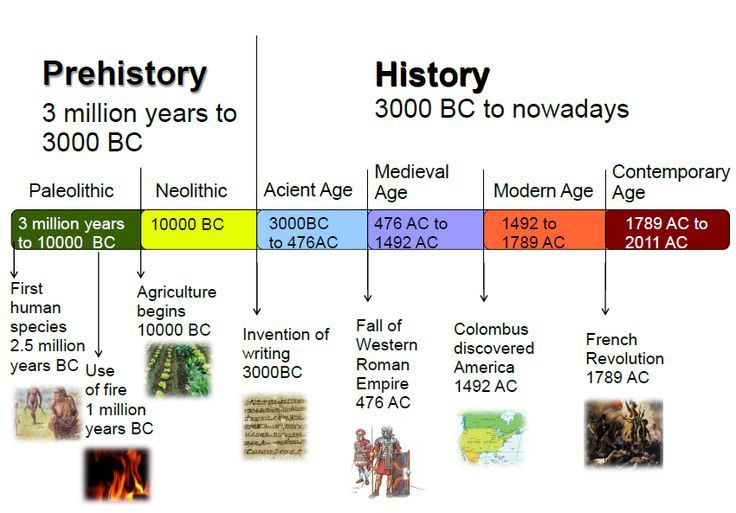
Beginning of Agriculture Period : About 10,000 years ago (8000 BC) Region : Ancient Fertile Crescent — present-day Iraq, Syria, Lebanon, Turkey, etc. Humans abandoned hunting and gathering and began cultivating crops and raising livestock . Domestication of wheat, barley, peas, sheep, and cattle began. Agriculturelaid the foundation for permanent settlement in human history and later the birth of civilization .
Use of Metals
Chalcolithic / Copper Age: Period: Around 4500–3300 BC Copper began to be used in ancient societies, although stone continued to be used.
Bronze Age: Period: 3300–1200 BC, bronze was made by mixing copper and tin — more durable, Bronze Age civilizations developed everywhere in Mesopotamia, Egypt, India, China
Iron Age: Period: Began in various regions between 1200–500 BC, iron was more powerful and readily available — revolutionizing agriculture and weaponry.
First actual script:
- Sumerians (Mesopotamia): They developed cuneiform script around 3200 BC . It was the world’s first true writing system.
- Egyptians: Hieroglyphics were introduced around 3100 BC .
- Indus Valley Civilization (Harappan script): Used around 2600 BC , but has not yet been discovered.
- Chinese Oracle Bon Script: Used in the Shang Dynasty around 1200 BC , mainly for fortune telling.
Timeline Summary:
| Events | Estimated duration | Region |
| The beginning of agriculture | 8000 BC | Fertile Crescent |
| The beginning of civilization | 3500–3000 BC | Mesopotamia, Egypt, India, China |
| Copper Age | 4500–3300 BC | Different regions |
| Bronze Age | 3300–1200 BC | Eurasia |
| Iron Age | 1200–500 BC | Different regions |
We can see that the 300,000-year history of Homo sapiens found in the fossil record and the history of the past 5,000 to 6,000 years ago are completely different. All the major milestones in history such as agriculture , civilization , writing system and metal use have been passed by humans very recently. However, according to the theory of evolution, Homo sapiens has been living on earth for more than 300,000 years. The skull of about one million or one million years old discovered in the Yunxian region of China recently, called “Yunxian 2”, was initially identified as part of Homo erectus, but through modern digital reconstruction methods, it has been identified as belonging to the Homo longi species. This means that different species of human-shaped people have lived on earth for millions of years.
So, it is easy to ask why, despite living on Earth for millions of years, humans have not been able to truly establish any civilization?
6. So is the theory of evolution true?
No, the fossil record does not prove that the theory of evolution is true. Evolution means that one type of animal gradually transforms into another type of animal through the process of natural selection and mutation. The fossil record shows evidence of the existence of various types of animals millions of years ago, but there is no evidence of continuous transformation. Moreover, it is almost impossible to get a complete idea of the intelligence of an animal from fossils. However, intelligence is such an extraordinary thing that makes Bani Adam completely different from all other creatures. About 98% of genetic similarity can be found between humans, chimpanzees, and monkeys. However, chimpanzees, monkeys are much less intelligent animals than humans. They are forest animals and humans are the kings of the earth. Despite having 98% genetic similarity, these animals are not comparable to humans in any way. The reason for this is basically one thing, which is intelligence, the power of the brain. Although there is a great deal of genetic similarity between humans and primates, the human brain has some special features that set us apart from other animals.
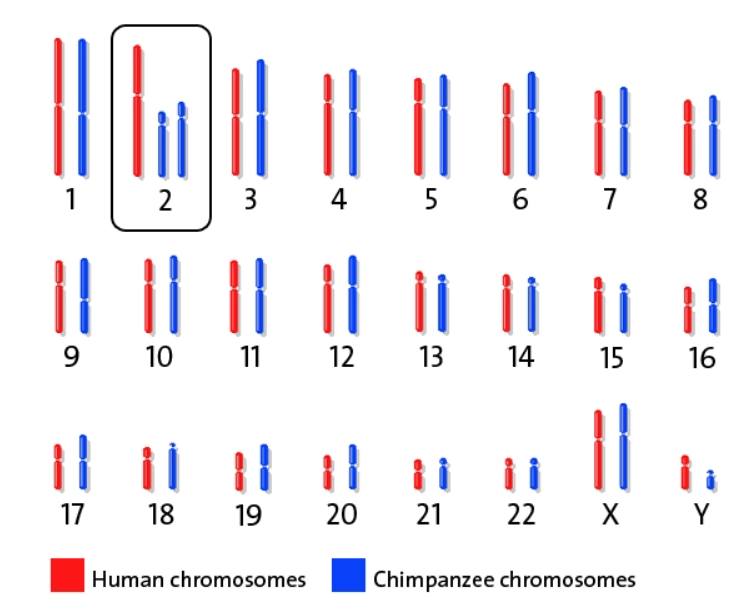
Image: Chimpanzees share about 98% genetic similarity with humans, but there is a huge difference in intelligence between them.
The human brain has a more developed cerebral cortex than other animals – especially the prefrontal cortex , which helps with planning, reasoning and decision-making. Primates also have a cortex, but it is not as developed as humans. The human brain has about 86 billion neurons, while the chimpanzee brain has 28 billion neurons. The human brain has much more developed Broca’s area (the ability to speak) and Wernicke’s area (understanding language). As a result, humans can produce and use complex language, which primates cannot. The human brain has denser and more complex synaptic connections. This results in coordination between different brain regions, which makes abstract thinking and higher creativity possible. The fossil record shows some limited examples of tool use, memory and social behaviour, but no evidence of symbolic thought, science, art and culture like that of modern humans.
According to the fossil record, humans lived 50,000 years ago. But we have seen from the discussion of the milestones of human history, i.e. the formation of civilization, agriculture, and the use of metals, that these have only developed in the last 5,000 to 6,000 years. That means there must be a huge difference between Bani Adam and these human-shaped creatures. Otherwise, civilization, art, and literature would have developed long ago.
In my opinion, the main difference between the descendants of Adam (AS) and all these previous hominids is in knowledge and intelligence. This is also hinted at in the Quran in verses 31 to 33 of Surah Al-Baqarah. In these verses, Allah mentions that Adam (AS) was given special knowledge after his creation:
And He taught Adam (peace be upon him) the names of all things, then He presented them before the angels and said, ‘Tell Me the names of these things, if you are truthful.’
They (the angels) said, “Glory be to You, we have no knowledge except what You have taught us. Indeed, You are the All-Knowing, the All-Wise.”
He said, ” O Adam! Inform them of the names of these things.” When he had informed them of their names, He said, “Did I not tell you that I know the unseen in the heavens and the earth, and that I know what you reveal and what you conceal?”
These verses show that Allah Almighty taught Adam (AS) something special or gave him some special knowledge that no one else except Adam (AS) – not even the angels – knew. According to the commentators, Allah gave Adam (AS) knowledge of various objects in the universe. This knowledge is what made Adam (AS) special and distinguished him from other creations.
So Sahelanthropus tchadensis, Australopithecus, Homo habilis, Homo erectus, Homo sapiens – none of these species that resemble humans are descendants of Adam. They are different species. They have no genetic relationship with Bani Adam, no matter how much they are physically and genetically similar.
The fact that Adam (peace be upon him) was a completely separate creation is made very clear in the Quran:
Surah Al-Sad 38:71-72
“When your Lord said to the angels: I am creating a man from clay, then when I have perfected him and breathed into him of My spirit, then fall down before him in prostration.”
Surah An-Nisa 4:1
“O mankind! Fear your Lord, who created you from a single soul and from it created its mate, and from them both spread out many men and women. ”
Conclusion
1. Adam (peace be upon him) came with knowledge, intelligence, language, religion, etc., he was not the product of gradual evolution. He is referred to as the ‘Caliph’ and he replaced other Hominid animals.
2. All civilizations have developed through the descendants of Adam (a.s.) over the past 6,000 to 7,000 years.
3. Although Homo sapiens lived on earth for about 300,000 years, they were not intelligent enough, so no civilization developed during this long period.
4. Even though they are physically and genetically similar, two animals can be completely different due to differences in intelligence. For example, humans and chimpanzees. Although they are 98% genetically similar to humans, chimpanzees have much lower intelligence.
5. Physical and genetic similarity – does not provide any definitive evidence for the transformation from one animal to another, but rather it is an idea or possibility. This possibility is discussed in the theory of evolution.
The Quran tells us that Adam (AS) was the first human being, whom Allah created directly from the dust. He was given special knowledge and honor . He was the father of mankind, the first prophet and was chosen as Allah’s vicegerent on earth . From the descendants of Adam (AS) came the modern intelligent man who established a true society and civilization. Hominid animals that looked like humans lived on earth long ago, but they were not intelligent like humans. Their brain shape and structure were different. They were different from the descendants of Adam (AS). They could not establish any civilization or civilization. Modern knowledge, science, civilization, art and culture originated through the descendants of Adam (AS). The things that we are being taught through the theory of evolution are part of human ideas. They are not irrefutably proven.
Related Post-
Evolution theory vs. Adam and Eve theory-1
Reference :
- Smithsonian National Museum of Natural History
“ Human Evolution Timeline Interactive .”
https://humanorigins.si.edu/evidence/human-evolution-timeline-interactive
( A reliable timeline of the stages of human evolution — with detailed information about Sahelanthropus, Australopithecus, Homo habilis, erectus, neanderthalensis, sapiens, etc. ) - Ibn Kathir, Tafsir al-Qur’an al-‘Azim , Vol. 8, Dar al-Taybah edition, commentary on Surah Nuh (71:1).
- Ibn Kathir, Al-Bidaya wa’l-Nihaya , Vol. 1, Dar al-Fikr edition, p. 91.
- Al-Tabari, Tarikh al-Rusul wa’l-Muluk (History of Prophets and Kings), Vol. 1.
- Ibn Manzur, Lisān al-‘Arab , root: خ ل ف, Vol. 9, p. 83, Dar Sadir edition.
- Al-Raghib al-Asfahani, Al-Mufradāt fī Gharīb al-Qur’ān , entry: خَلِيفَة, Dar al-Ma’rifah edition.
- Smithsonian National Museum of Natural History – Human Evolution Evidence: Brain Size Over Time.
https://humanorigins.si.edu/evidence/human-evolution-evidence - Neubauer, S. et al. (2018). “The Evolution of Modern Human Brain Shape.” Science Advances , 4(1), eaao5961.
- Prüfer, K. et al. (2014). “The Complete Genome Sequence of a Neanderthal from the Altai Mountains.” Nature , 505, 43–49.
- Hublin, J.-J., & Stringer, C. (Eds.). (2012). Neanderthals Revisited: New Approaches and Perspectives. Springer.
- Florio, M. et al. (2018). “Human-Specific Gene ARHGAP11B Promotes Basal Progenitor Amplification and Neocortex Expansion.” Science , 347(6229), 1465–1470.